What a working light can’t tell you
We see what others miss, here’s why it matters
The challenge
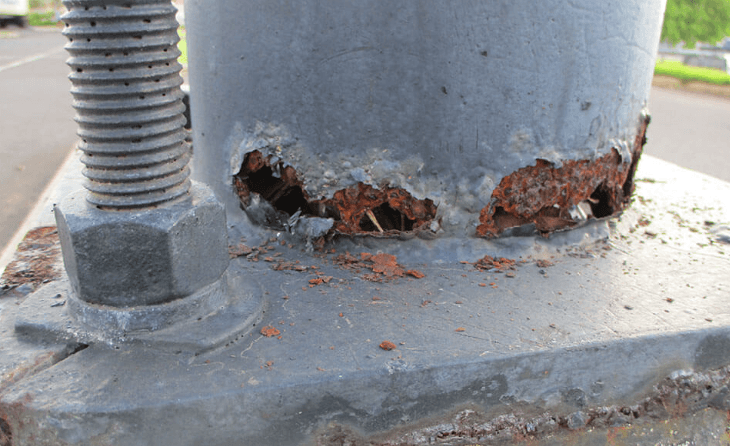
The car park had 25 lighting columns on its top deck. When our engineer surveyed the site in February 2026, five had already been removed after corrosion caused them to fail over time, and a replacement steel column had been put in. The other columns were the same age and type, and they had spent years in the same exposed coastal conditions, where salt in the air speeds up corrosion. Corrosion inside a column is often overseen because viewed as being surface level only, rather than considering the structural ramifications and the chemical reaction that continues to eat into the metal.
Our expert team reviewed the condition of the remaining columns and identified severe structural deterioration wtih some columns having pin holes exposed due to the oxidisation and rust. Following this visit a recommendation was immediately provided to take down all the remaining original columns before anything else came down, posing a major risk to life and subsequent replacement them with new columns and luminaires.
Making the site safe
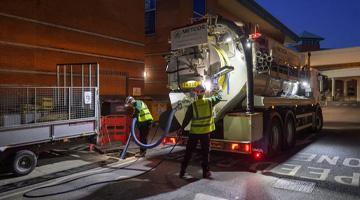
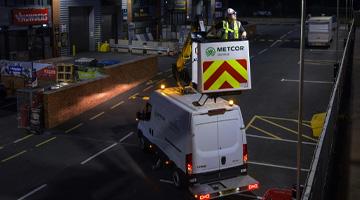
Upon instruction we expedited the works to make the site safe. Barriers kept pedestrians out of the work area, and each circuit was safely isolated, locked off and proved dead, in line with NICEIC guidance before work started.
The columns were raise-and-lower types, so the team lowered each one and removed the luminaires, brackets and signage, which were kept for the client. They then cut the removed lighting columns into sections so they could be removed and disposed of safely in line with WEEE regulations. Each stump was wrapped and taped to keep water out of the base. Before the team left, the circuits were reinstated and tested.
Scope of work
Taking the columns down dealt with the immediate risk. Before new columns could go up, the foundations and mounting studs had to be checked properly. We arranged for an independent chartered engineer to inspect all foundation blocks and run ultrasonic non-destructive tests on the holding down studs and associated infrastructure.
The results gave a clear scope for the work. Twenty-three foundation blocks were in good condition and could be reused. Two needed repair: one had deep cracking and corroded reinforcement, and the other had a construction defect that left steel reinforcement exposed. Both issues if left unchecked, could and resulted in further hazards to life occurring onsite with more metal, heavy lighting columns falling within a public car park. On one base, M16 and M20 studs had been mixed and a nut was missing. Across the whole site, the existing studs stuck out only about 30mm, which is too short for new flanged columns that need at least 45mm. The engineer recommended cutting every stud flush and fitting new resin-anchored studs, with pull testing to prove each one is installed correctly. Deterioration in the deck waterproofing was also flagged for specialist attention.
The outcome
The client now has not only answers to why the columns were falling but a replacement scope based on evidence rather than assumption. Reusing sound foundations avoids unnecessary demolition and waste, keeps costs down and cuts the environmental impact of the project. Problems that could have caused a new column to fail are dealt with before it goes up.
Conclusion
A lamp check only tells you whether a light works. It says nothing about the steel inside the column, the concrete under it or the studs holding it down. Our lighting PPM includes structural testing, torque checks on connections and full records for every external asset, so problems are found while they can still be planned for.

